I Thought Winter Was Punishment
I spent many winters curled up in the window seat of my childhood bedroom, my nose pressed firmly against the cold glass. Experiencing the sun on my skin felt like a religious experience, and as a child I never knew why—I just knew it mattered. Sprawled out in the classroom downstairs (our home office), I would chase the sun across the hardwood floors while tinkering with bits of yarn, Lincoln Logs, and counting bears. My favorite ritual was dumping all the crayons out of the bin and sorting them into “families”—their different shades. Much of my childhood play consisted of organizing and sorting, fussing over the way things were in a home with seven people.
Winter seemed to sink into my bones by the time I was a teenager. I wrote about it in my diary as if it were death knocking at my door, because at fifteen it felt entirely that way. Looking back through scribbles, drawings, and collages, there was always a constant theme of it coming back for me every few months. I felt caged in and terrified by winter.
Once, when I was sixteen, I walked an icy mile home from a friend’s house in the dark and felt strangely enlightened by the punishment winter had for me. Cold, walking, darkness—it all felt earned. I remember being shocked to discover how upset both sets of parents were that I hadn’t asked for a ride home. At the time, I couldn’t understand why anyone would want to interrupt something that felt so clarifying.
I hated asking for help and rejected the idea altogether at a very young age. As the middle child of five, I quietly gloated in my teenage freedom, flying just below my parents’ radar as they prepared for their first grandchild. I experienced an unusual amount of agency that felt singular within my family dynamic. In the winter, I kept my notebook and an autobiography of a brain surgeon bound together with a burgundy belt—definitely one of my sisters’—and rode my bike to a very old park in my city…
Winter has inspired a great deal of my work, though I didn’t always recognize it as such. The quiet, the confinement, the repetition of days—all of it pushed me inward. Writing, making, sewing, sorting—these became ways to metabolize the season, to give shape to something that otherwise felt endless. Much of what I’ve made over the years carries winter in it, whether I meant for it to or not.
Largely unknown to me—perhaps because of the Tumblr-influenced years I grew up in—I was underweight throughout many periods of my teens and early twenties. I proudly wore children’s clothing and survived on ice cream sundaes and pretzels, never giving it much thought beyond the fact that I was always bitterly cold. Looking back, it rarely occurred to me to consider my weight questionable at all, which I can attribute to the privilege of existing in a society that rewards thinness. I loved photographing myself, and I had mirrors on nearly every wall of my teenage bedroom in a way I can now admit was insatiably vain.
When I turned twenty-two, I was so cold that I spent the entire summer in an oversized Express hoodie, my trusty space heater never more than two feet away. I was miserable to be around—insisting every meal be eaten outside in direct sunlight, refusing cold air-conditioned restaurants, demanding the seat warmer be turned on during every car ride. I had a few boyfriends who handled this well, maybe because it reassured them that I needed them, that I might wither away into the cold without their constant prodding.
There was one winter when I found myself on bed rest for an entire week, followed immediately by a Southern snowstorm that kept me home for another. Time felt as though it had completely ceased. On a phone call with my mother—who had already driven a 1.5-hour round trip twice to check on me—I was literally crawling into my kitchen, pushing myself up onto a chair just to open the pantry. I was dangerously dehydrated and feverish. She sternly but lovingly said, “You refuse to ever ask for help. Why won’t you let us help you?”
The next evening, somewhere between crying and sleeping, I crawled to my bedroom door and lay flat on my stomach just to see the light from the living room beneath it. I had punished myself to the darkness, where the sky outside was the exact same shade of gray both day and night.
I’ve written a lot about winter. The majority of my diaries are stories about it—mostly fear. Fear that it will swallow me whole, that the long nights will never end, that I’ll be plunged into a never-ending nightmare of iced-over roads and confinement to my home, which I love but cannot bear the thought of being confined within.
I’ve always associated winter with crawling—on scraped hands and knees, fumbling forward toward spring. Winter was something to endure slowly. No holiday mattered more to me than Groundhog Day; a groundhog genuinely held my emotional state in its hands. The idea that relief might be declared, that light could be promised, felt monumental.
Fearing winter felt like a kind of divine suffering, proof that I deserved warm summer days and vacations. Scrupulosity—also known as religious obsessive compulsive disorder—engulfed me from childhood into my early twenties, and suffering made me feel closer to belonging, even after choosing atheism in middle school. It’s difficult to put into words now, partly because I find it embarrassing how casually shame and suffering shaped my life from such a young age. Suffering for the sake of suffering felt worthwhile. I felt seen in characters like Nina from Black Swan and Heather Chandler from Heathers, where perfection and sustained suffering felt like a fair trade. I never self-harmed in the ways most recognizable in my teen years, but I practiced deprivation daily—of rest, of ease, of care—and it took years to unlearn.
Perfectionism consumed my early twenties. Every ounce of energy went toward being the best in every avenue of life—career, dating, fitness, diet. I tried to outrun the longest season of the year and treated rest as laziness. Rest was penance to be paid once the nights became long, dark, and cold. In the summers, I nearly refused sleep altogether, demanding myself to stay outside, to enjoy every moment of sunshine, to never complain, to move my body, to lie in the grass—because one day I would wish I had.
Last year, I finally asked my therapist for a formal assessment of my mental health while anxiously bracing for winter in cutoff shorts and a halter top in mid-July. With that decision, and many difficult but honest conversations that followed, I became medicated for the first time in my life.
I grew up very holistic, as many people know about me. I’ve practiced cycle syncing for years and was unofficially tasked with tracking my sisters’ cycles. As someone deeply in tune with the female body, I always disdained my luteal phase because it demanded rest—an irony, considering I’m a Taurus.
Despite strong genetics, a resilient immune system, and a high metabolism, I was fiercely against medication after a traumatic experience with birth control as a teenager. I associated SSRIs with giving up—with laziness, failure, not being good enough. It took months for my body and mind to accept the relief medication brought to my SAD and OCD symptoms. I never realized how much I ruminated until it stopped. I never saw how many compulsive rituals filled my day—both physical and mental—until I began consciously releasing them.
One of my biggest obstacles in therapy has been learning to balance rest with momentum. I always assigned more value to working myself to the bone than listening to what my body was begging for. It’s something I still work on daily, but a truer balance has begun to emerge.
Most of all, I had no idea how much rest I was missing. And frankly, I was angry when I realized it. I spent last Christmas break in bed. I slept deeply and well—wrapped in silk pajamas, a bonnet, and layers of quilts, blinds drawn. I slept without fear of missing anything. Sewing projects, cold tea, and donut remnants littered my nightstand, but mostly I slept. I downloaded phone games—something I once deemed lazy and wasteful—and spent money building tiny houses and chopping down trees. I FaceTimed friends and went to the gym most mornings, but mostly… I slept.
As someone who demanded five cycling miles on an empty stomach at twelve years old before allowing food or water, rest became something entirely new. Rest looked like sitting in my pink bedroom chair, embroidering while watching TV—yes, TV—once my ultimate symbol of wasted time.
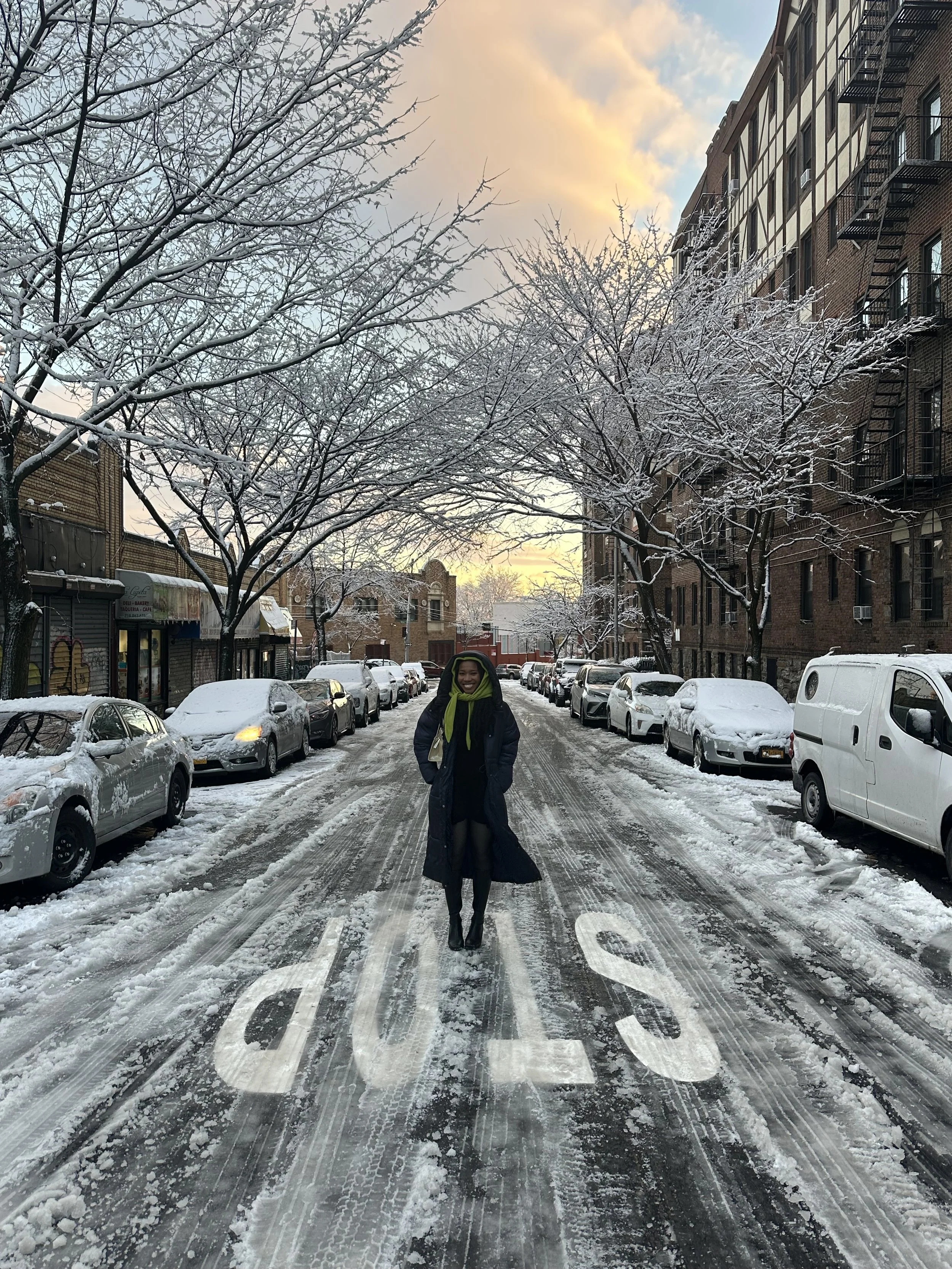
As 2025 became a year of surrender, change, and abundance, I chose to spend my winter break in my favorite city: New York. Between train rides to see best friends, a day in Manhattan surrounded by bolts of fabric in the garment district, and an intimate date night on an empty studio floor under pink lights and tangled plants—Thai food balanced on our laps atop a purple brocade sofa—I spent most of the week nestled in a familiar apartment. I ran my fingers along dusty textbooks and family photo albums, watched the first snowfall, sank into a quilt-covered sofa, sewed to jazz drifting from the kitchen radio, and accepted meals prepared for me by kind hands.
So far, this has been the most enjoyable winter of my lived memory.
Winter still shows up in my work now, but differently. It’s in my preference for quiet processes, for repetition, for working with my hands in slow, deliberate ways. It’s in the way I’m drawn to soft interiors, familiar objects, and warm, homemade meals for one.
As I continue to reimagine winter, my fear of what it might punish me with has softened into curiosity about what it might offer me.
As I wrote while closing my diary at the end of last year, “I no longer brace for impact but soften for embrace.”